Crown of England
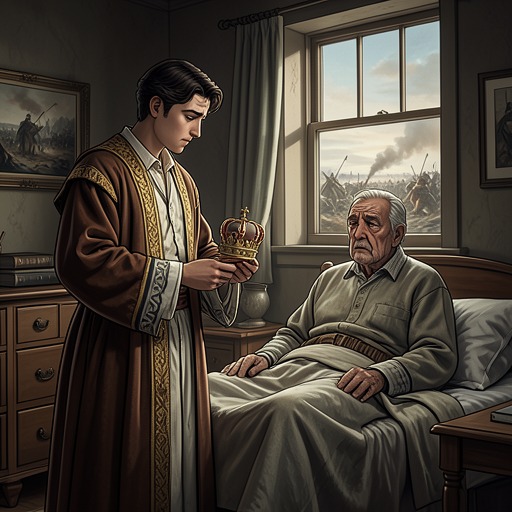
Henry IV, Part 2The Crown of England becomes most significant when it is removed from the place where King Henry IV has set it beside him. On the pillow, it is at once a physical object within reach and the emblem of a political burden that no longer rests easily on its wearer. Prince Henry’s return of it makes the crown a point of encounter between a dying king and the successor who must take up the office beyond the limits of the king’s failing body.
Placement and Physical Presence
King Henry IV explicitly asks for the crown to be set on his pillow. That placement brings the emblem of rule into the intimate space of rest, rather than leaving it as a distant object of ceremony. The pillow should offer ease, but the crown beside it turns the king’s bed into a place where political authority is physically present. The object’s proximity makes the burden of kingship hard to separate from the body that bears it.
The crown is not merely reported as an abstract symbol: the king later asks, “Where is the crown? who took it from my pillow?” His question fixes its location and registers its absence as an immediate concern. Warwick answers that the attendants left it there when they withdrew. The exchange establishes the crown as a particular, movable object whose presence can be checked and whose removal demands explanation. Its meaning in the scene depends on that material fact: it can be lifted from the pillow, carried away, and brought back.
The Crown and the Burden of Rule
The crown’s place beside the bed gathers into one image King Henry IV’s reflections on sleep and sovereignty. He contrasts the thousands of his poorest subjects asleep with the king who cannot command the same ease; his meditation ends, “Uneasy lies the head that wears a crown.” The object marks a distinction between the ruler and those who can lie down without carrying the responsibilities of rule. Its weight is not described in physical measures, but the king’s words make the crown’s political cost felt through the denied comfort of sleep.
Prince Henry, left alone to watch by the king, also sees the crown on the pillow and calls it a “troublesome bedfellow.” His response turns his father’s complaint into a sharply focused image: the object shares the bed, yet it does not comfort the person beside it. The crown is figured as both companion and disturbance, intimate enough to lie at the king’s side and troublesome enough to make the bed itself an emblem of care. Prince Henry’s attention to it places him in the same chamber as the burden he will inherit, though at this moment the object is still his father’s to command.
Removal, Return, and Inheritance
When King Henry IV discovers the crown missing, his question makes its removal a crisis of meaning as well as location. He asks why Prince Henry took it, then sends the others away so that father and son can speak alone. The private meeting gives the object a role in their relationship: the crown has passed briefly from the king’s pillow into the prince’s possession, and its return requires an explanation between them.
Prince Henry brings it back and acknowledges the course of events before placing it in his father’s hands: “There is your crown.” He presents the return not as a claim to keep the object but as a response to the rebuke he expects his action to have caused. The gesture restores the crown to the king’s keeping while making the coming succession impossible to ignore. The object has been taken from the pillow and returned, but the exchange exposes the difference between possessing the crown for a moment and inheriting the authority it signifies.
King Henry IV frames the crown’s future in terms larger than the bedside encounter. He speaks of “Harry the Fifth” as crowned and of royal state giving way, then receives the crown back from Prince Henry. Near the end of his speech, he says, “How I came by the crown, O God forgive;” and asks that it may live in true peace. The crown therefore carries the memory of the king’s own acquisition of power as well as the prospect of his son’s rule. The prayer does not erase that history; it makes the object’s passage forward a matter of moral and political hope.
The Office Beyond the Wearer
The scene holds together a vulnerable king and an office that can continue beyond him. King Henry IV’s sleeplessness and failing strength belong to his person; the crown, however, remains transferable. It rests on his pillow, disappears from it, and is returned, while the language of succession already names the next king. The difference between the ruler’s body and the durable authority represented by the crown is thus staged through a simple movement of an object in a chamber.
After the transfer, Prince Henry appears as King Henry V before the Lord Chief-Justice, who gives him the “unstained sword” associated with the administration of justice. That later encounter shows the new king entering public office through an act of authority, while the bedside scene has made the crown’s inheritance personal and fraught. The Crown of England matters not only as the sign of who rules, but as the material focus through which the play joins a king’s anxiety, a son’s act of return, and the uncertain hope that power may pass into a more peaceful reign.